

For years, gasoline-powered scooters have been the efficiency benchmark for urban commuting and short-distance transportation.
Particularly in the 150cc segment, power, comfort, and maintenance costs reached a well-balanced and highly mature state.
However, in recent years, a shift has emerged that enterprise decision-makers can no longer ignore:
electric motorcycles are moving from being a mere alternative to becoming an option that requires serious, structured evaluation.
This shift is not driven by a single factor.
It is the result of simultaneous progress in technology, cost structures, and real-world usage scenarios.
From “Riding Comfort” to “System Efficiency”
Traditionally, the advantages of gasoline scooters were defined in comparison to standard motorcycles:
- relaxed riding posture
- stable suspension
- practical cargo and passenger capacity
These characteristics made them the default choice for daily commuting and high-frequency use.
On electric platforms, however, these features are not only replicated — they are redefined in two critical dimensions:
- operational smoothness
- environmental impact, particularly noise and vibration
The nature of electric motors allows near-instant, linear power delivery during low-speed starts and frequent stop-and-go riding.
In dense urban traffic, this difference becomes increasingly pronounced.
The result is not only reduced rider fatigue, but also lower noise pollution — a factor that has become especially relevant in logistics, delivery, and nighttime operations.
This is one of the key reasons electric motorcycles have seen growing adoption in food delivery and last-mile logistics over recent years.
Power Responsiveness and Safety: Hidden Benefits in High-Frequency Scenarios
In congested urban environments, controllable power response often matters more than peak output.
Electric motorcycles deliver instant torque, enabling more predictable acceleration during lane changes, starts, and evasive maneuvers.
At the same time, electric platforms make it easier to integrate electronic control systems such as traction control, regenerative braking, and wet-surface riding assistance.
While these advantages may be difficult to quantify on a per-ride basis,
their value compounds significantly under high-frequency, large-scale usage, where stability and risk reduction directly impact operational outcomes.
An Industry Inflection Point: Three Historical Pain Points Are Being Systematically Addressed
1. Range: From Anxiety to Predictability
Advances in battery energy density and power management systems have pushed real-world range forward at a steady pace.
Today, many flagship electric motorcycles offer practical ranges exceeding 120 kilometers, sufficient to cover a full week of typical urban commuting or short-distance operations.
Industry consensus increasingly points to 2026 as a key commercialization milestone for higher-density battery technologies.
Once these solutions reach maturity, range is expected to fade as a primary constraint on electric motorcycle adoption.
2. Cost: From Per-Vehicle Accounting to System-Level Economics
Compared to 150cc gasoline scooters, electric motorcycles present a fundamentally different cost structure:
- significantly lower energy costs
- minimal routine maintenance
- reduced operational complexity
When usage shifts from individual commuting to high-frequency or fleet-based operations, these differences are magnified.
Over time, they begin to influence not only operating expenses, but also budgeting models and long-term asset planning.
At this stage, organizations are no longer comparing vehicles —
they are comparing operating systems.
3. Energy Replenishment: From Charging to Infrastructure
Solving energy replenishment is not merely about faster charging speeds.
It is about how energy access is organized at scale.
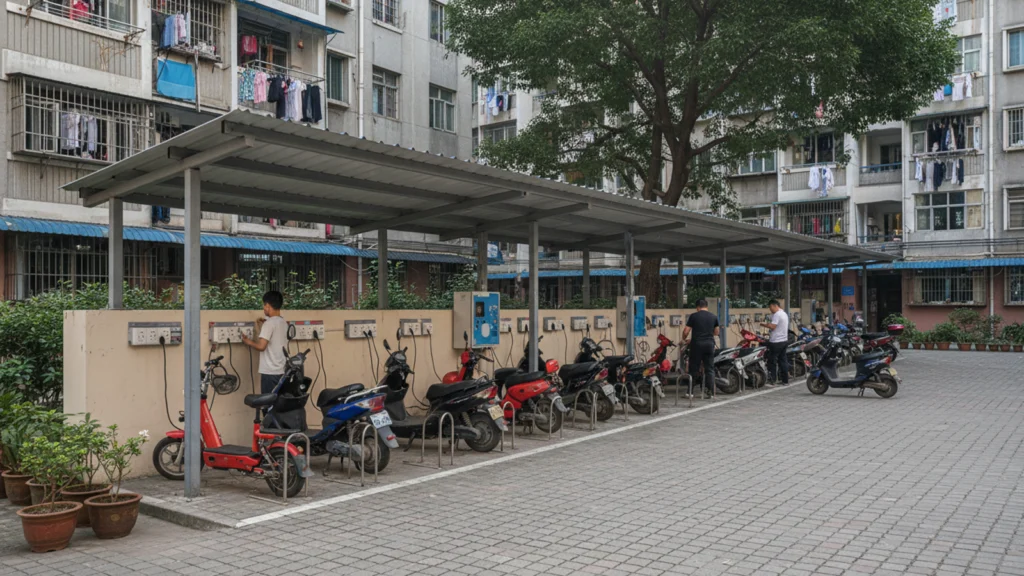
The growing deployment of battery-swapping networks has made “full power in minutes” a practical reality, with convenience increasingly approaching that of traditional refueling.
For continuous-use scenarios such as delivery and urban mobility services,
this model represents a structural challenge to the efficiency advantage long held by gasoline-powered systems.
A Distinct Advantage of Electric Platforms: Manageability and Upgradability
Unlike gasoline scooters, electric motorcycles are inherently digitally manageable assets.
Common capabilities now include:
- remote vehicle status monitoring
- usage data tracking
- over-the-air (OTA) updates
- platform-based electronic control integration
These features allow electric motorcycles to function not merely as vehicles, but as assets that can be incorporated into enterprise management systems.
For organizations evaluating fleet efficiency, operational transparency, or long-term maintenance planning, this represents a capability gap that traditional platforms struggle to close.
Why the 150cc Segment Marks a Structural Boundary
The 150cc category has long been regarded as the “sweet spot” for gasoline scooters.
Yet this maturity also signals a plateau.
Performance improvements now deliver diminishing returns, while constraints imposed by engines and fuel tanks limit further gains in space utilization, safety integration, and intelligent features.
Electric motorcycles, by contrast, derive their performance ceiling from battery, motor, and control systems — technologies that remain in a rapid phase of evolution.
As range and energy access limitations continue to narrow,
advantages in performance, storage space, digital integration, and total operating cost become increasingly pronounced in high-frequency urban use cases.
A Question for Decision-Makers
The immediacy and mechanical appeal of gasoline scooters will remain relevant for many years.
They are not disappearing overnight.
However, for industries and organizations dependent on frequent, short-distance urban mobility, the more relevant question may no longer be:
“Should we consider electric motorcycles?”
But rather:
“When should we begin a structured evaluation of the costs, risks, and organizational impact of transitioning to electric platforms?”
That moment is approaching faster than many expect.

